
PLATFORM · FLOW STUDIO · AGENT LAB · ORCHESTRATOR · REGISTRY
Build it visually. Run it governed. Prove it to anyone.
The AgentAnywhere platform is one runtime for the whole life of an AI agent: designed in Flow Studio by the people who own the process, extended in Agent Lab by engineers, executed by the Orchestrator as services with contracts, and recorded in the Registry with its author, versions and approvals. Model calls are designed to be masked and screened inside your perimeter, with a Trust Receipt for each masking call — your cloud, your jurisdiction.

In short
The AgentAnywhere platform is four products on one runtime. Flow Studio is the visual canvas for the operations analyst who knows the workflow. Agent Lab is the code-first surface for the engineer who has to wire the agent into core banking, a CRM or a ticketing system. The Orchestrator runs agents as services with contracts — routing, retries, idempotency, typed handoffs, durable state. The Registry keeps the agents and flows on record: agents with their author, version and approval status, flows with every saved version.
Governance is the floor, not a feature. Every call an agent makes goes through the Agent Universal Gateway, where it is authenticated and scoped; Kavach is designed to sit in front of the model as a proxy and screen each request for prompt injection and unsafe output, and Aavaran is designed to sit in front of the model, as an OpenAI-compatible proxy or as a mask-before-inference call that a gateway or agent runtime makes, so that raw data does not reach a model unmasked. Every consequential action waits for a named human. Every decision is recorded, in a trail an auditor can inspect. There is no governance-off mode, because the runtime does not have one.
It runs inside your perimeter — your cloud, your jurisdiction — region-pinned or air-gapped, with our model families, built on open foundation models we serve and govern ourselves, served from Model Hub. It is the runtime under everything else on this site.
Four products. One runtime. One record.
Teams usually buy these separately and spend a year integrating them. We built them to share a runtime, a permissions model and an audit trail from the first day.
Flow Studio
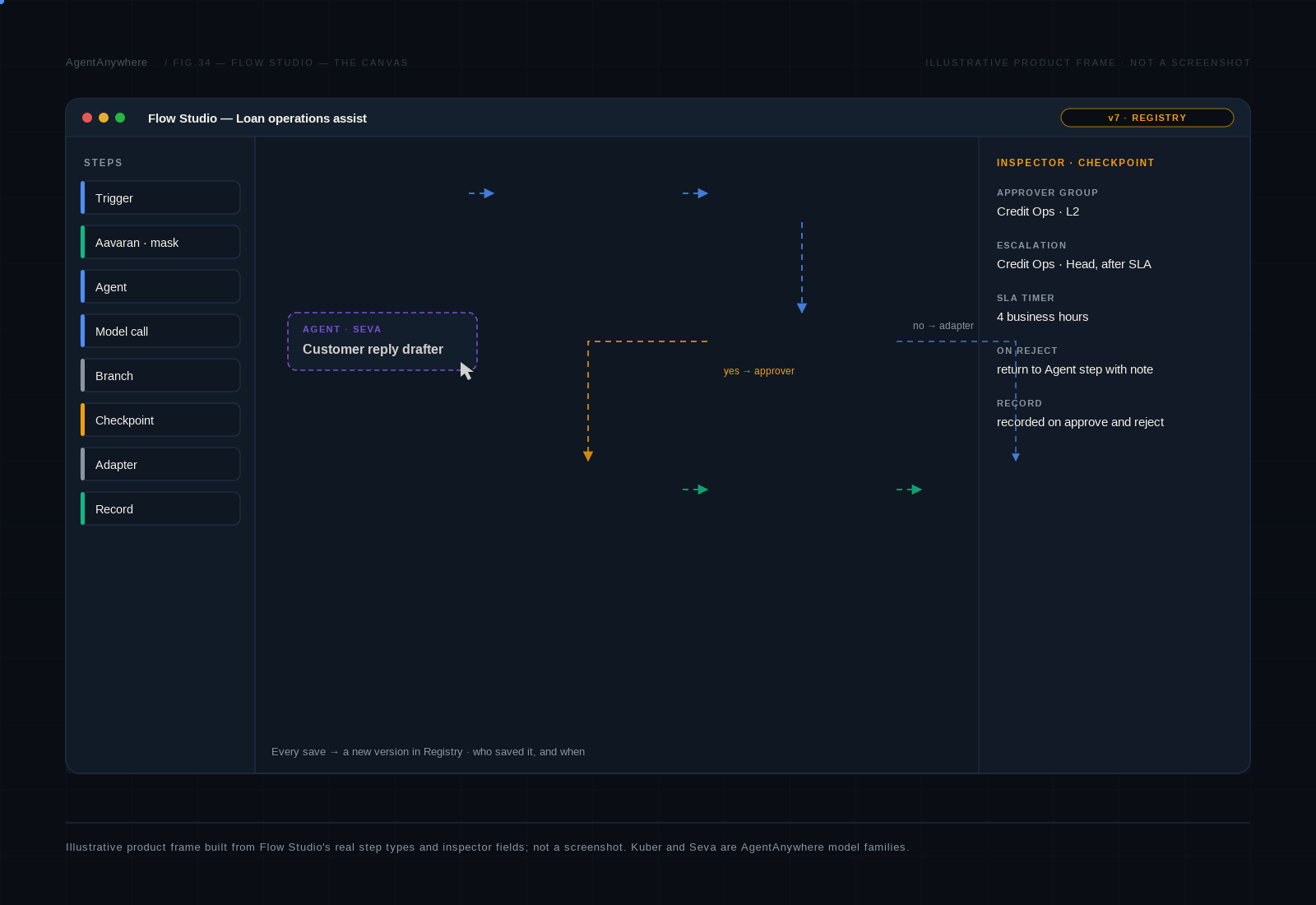
Visual agent design for the people who own the process. Drag-drop steps, branch logic, human-in-the-loop checkpoints, and a live preview that runs against the same runtime as production. Every save is a new version in Registry, with who saved it and when.
Agent Lab
Code-first development for engineers: TypeScript and Python SDKs, local debugging, structured prompts, golden tests, contract checks and an AI-safety checklist that runs before a request is applied. Flows authored here and in Studio are the same artifact — neither is a downgrade.
Orchestrator
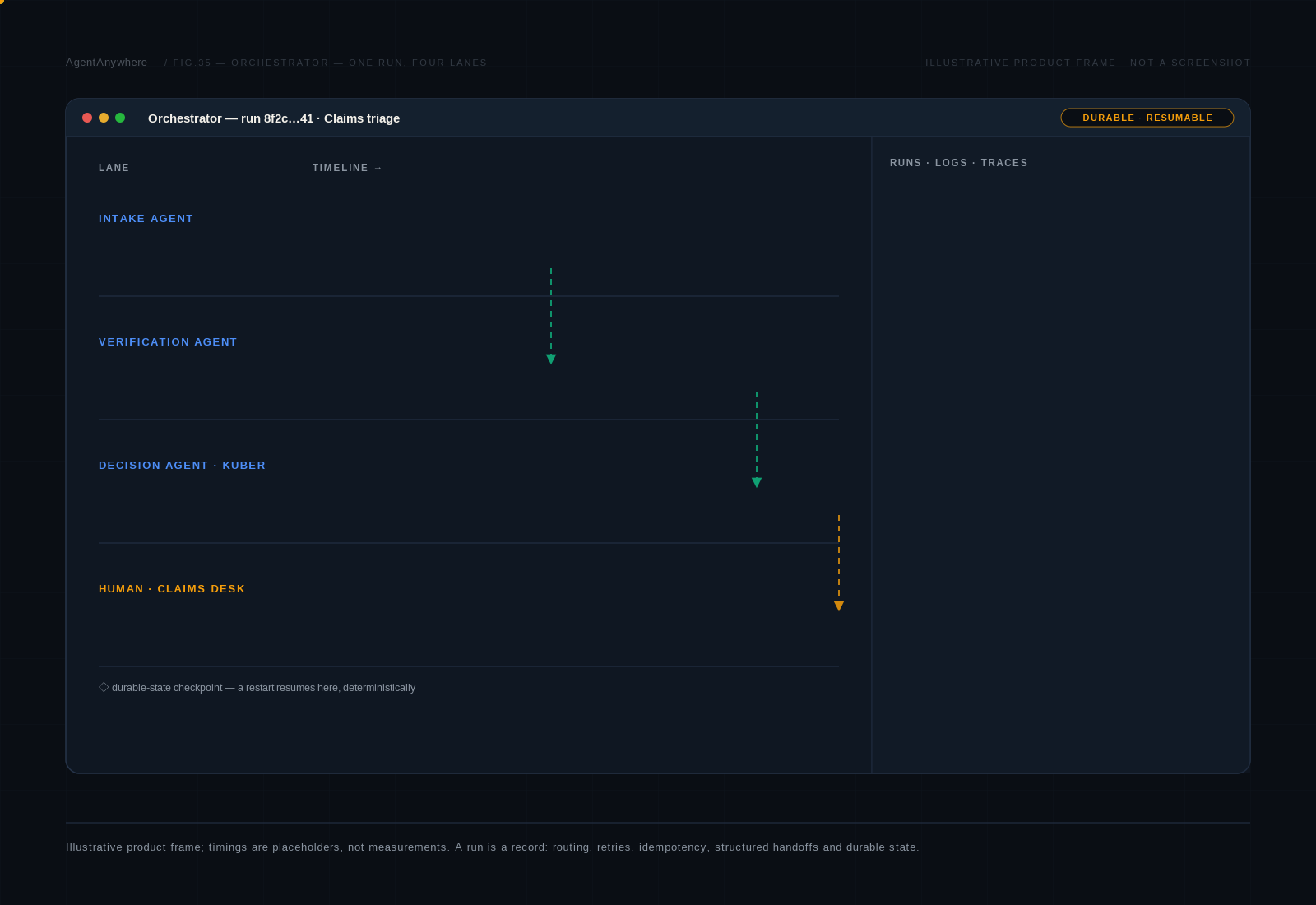
Multi-agent execution that treats agents as services with contracts. Routing, retries, idempotent steps, typed handoffs and durable state, with every step's fallback explicit and every restart deterministic. A run is a record you can replay, not a process you lost.
Registry
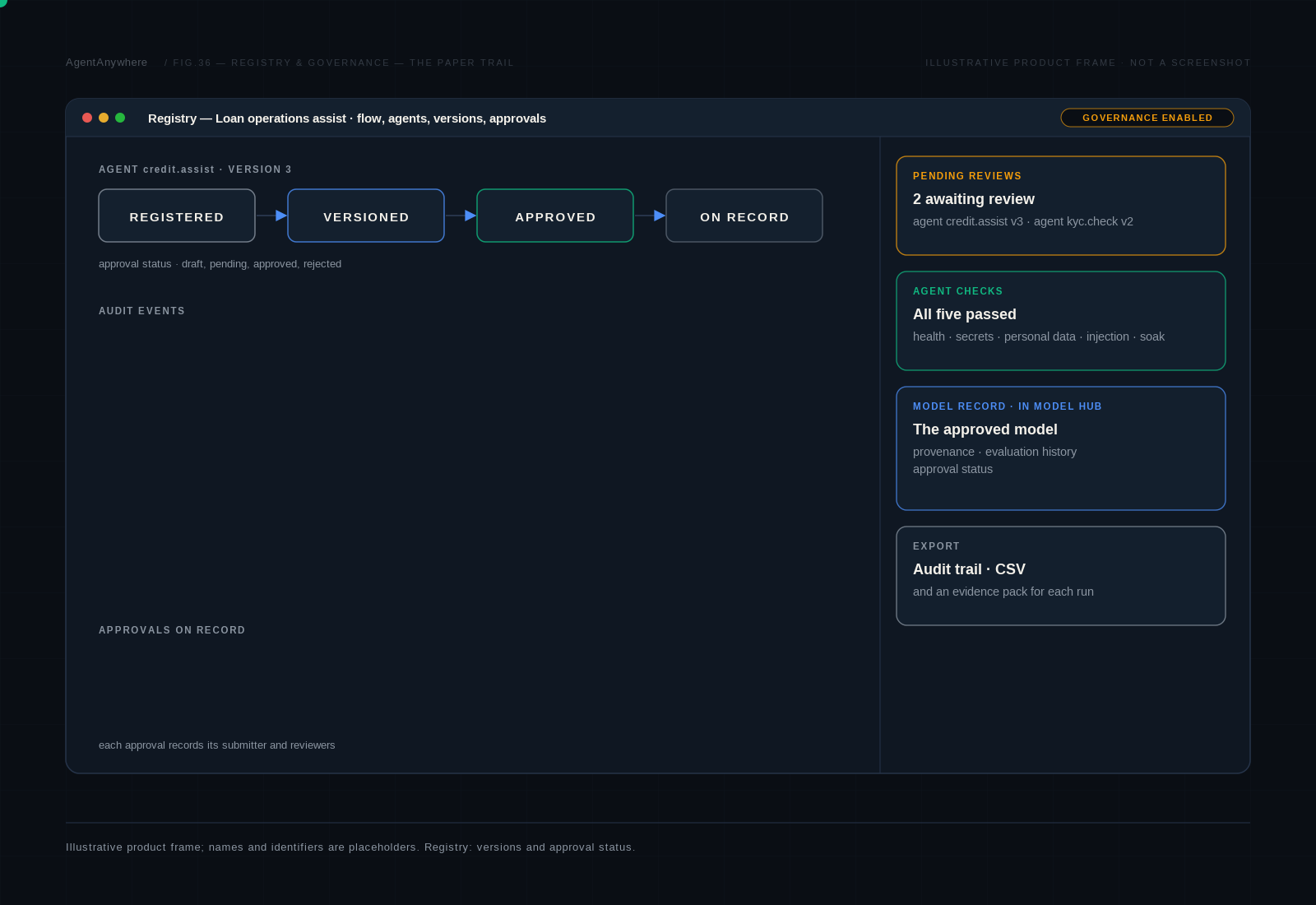
One inventory of agents and flows: agents with their author, version and approval status, flows with every saved version. It is what your audit team reads when an incident needs a paper trail.
Security on every call. Audit you can hand over.
Most agent tooling was built for the demo. This platform was built for the second meeting — the one with the risk officer in it.
In the path, not in a policy document
The Agent Universal Gateway applies policy on every request an agent makes, across nine protocols (MCP, A2A, HTTP/REST, AG-UI, ACP, GraphQL, WebSocket, MQTT and gRPC), from one control plane. Aavaran classifies PII, financial and regulated data and masks it — reversible tokenization or irreversible redaction — and is designed to sit in front of the model, as an OpenAI-compatible proxy or as a mask-before-inference call that a gateway or agent runtime makes, so the model sees only the masked value. Kavach is designed to sit in front of the model as a proxy and screen each request for prompt injection and unsafe output. Custodian produces evidence packs for continuous compliance.
Governance sits outside the model, where the agent cannot talk its way around it.
A record an outsider can inspect
Every mask and unmask writes a signed Trust Receipt — who, what, under which policy, when — and each block, approval and deployment is recorded. Receipts export as JSON and PDF for auditors.
The Registry keeps the flow and agents behind a run on record, the flow's saved versions and each agent's version and approval status, and Model Hub keeps the model's record. When the ombudsman asks in six months, the answer is a query, not an investigation.
Where regulated teams run it.
The same runtime, different rooms. Where a capability is a demonstration, the page for it says so.
PSU and private banks — loan operations
An ops owner designs the flow in Flow Studio: gather the file through adapters to core banking and CRM, mask it with Aavaran, run the checks with Kuber, and stop at a named approver before any decision leaves. Registry keeps each agent's approval status and who reviewed it.
Contact centres and BPOs
Assist, summarise and QA agents behind a masked transcript, with a clean handoff to a human when the customer needs one, and nothing retained that a client's data-residency clause would object to. Talk to us about Seva, the service-operations family, for this work.
Insurers and NBFCs
Claims triage as a governed flow: document intake, field masking, policy checks through adapters, and human review above a threshold you set — every step in the audit record.
Defence, border security and mission operations
The human-in-command pattern: the agent recommends, a policy outside the model blocks what must never happen, a named controller approves. Our mission-operations demonstrations use simulated telemetry with real governance code, and say so on screen.
Government and public-sector programmes
Citizen-facing agents on a region-pinned or air-gapped runtime, in Indian languages, with model provenance on record and every consequential action approved by a named officer.
Anyone facing an audit
Every consequential decision is recorded, in a trail that is queryable and exportable as CSV. That sentence is the platform's job description.
Designed for the people who actually run agents.
An agent in production has at least three constituencies: the engineer who built it, the operations team that monitors it, and the compliance officer who has to defend it. The platform gives each of them their own surface over one shared model of the agent.
An operations analyst changes a flow in Studio. The change is saved as a new version in Registry. The engineer sees the same change in Agent Lab and runs the golden tests against it locally. Not three platforms with brittle integrations — one platform, surfaced differently for each role.
Production-ready by default.
There is no separate enterprise edition that switches the production-readiness on. Sovereign deployment, governance and audit are the platform — not features bolted on when a regulator notices. Every flow you author deploys into a sovereign environment without rework; every agent is recorded with its version and approval status, and its actions are written to the audit trail; every model you select carries its evaluation history and approval status from Model Hub.
We do not promise that the first agent you build will be production-grade. We promise that the floor under it is, and that no engineering team has to build that floor before they can ship.
What we don't claim.
We do not claim the platform makes an agent correct — it makes an agent accountable, which is what lets you find out whether it was correct. We do not claim your systems must be replaced: adapters reach what you have, and anything else is an adapter or an MCP server away. The product frames on this page are illustrative, built from the product's own step types and panels; they are labelled as such and are not screenshots. And we do not claim certifications for your deployment: ShepHertz operates a control environment credentialed for SOC 2 and ISO 27001 and independently assessed for HIPAA and GDPR, and our alignment to the DPDP Act and RBI FREE-AI is designed-to-support — there to inform your assessment, not replace it.
FAQ
Frequently asked questions.
- What is the AgentAnywhere platform?
- The AgentAnywhere platform is a sovereign runtime for building, running and governing AI agents. It is four products on one runtime — Flow Studio for visual agent design, Agent Lab for code-first development, Orchestrator for multi-agent execution and Registry for the record of agents and flows — with a trust layer around it: the Gateway applies policy to every call, and Aavaran and Kavach are designed to sit in front of the model as proxies. It runs inside the customer's own perimeter.
- What is the difference between Flow Studio and Agent Lab?
- Flow Studio is the visual canvas for the people who own the process: drag-drop steps, branch logic, human-in-the-loop checkpoints and a live preview on the production runtime. Agent Lab is the code-first surface for engineers: TypeScript and Python SDKs, local debugging, structured prompts, golden tests and contract checks. Both edit the same versioned artifact, so neither is a downgrade of the other.
- How does the platform keep a human in control of AI agents?
- Consequential actions wait for a named human approver, defined as checkpoints in the flow with approver groups, escalation and SLA timers. Policy enforced outside the model at the Gateway blocks actions that must never happen regardless of what the model recommends, and every decision is recorded, in a trail an external party can inspect.
- How is security enforced on agent calls?
- Every call an agent makes passes through the Agent Universal Gateway. Aavaran classifies and masks PII, financial and regulated data, and is designed to sit in front of the model, as an OpenAI-compatible proxy or as a mask-before-inference call that a gateway or agent runtime makes, so that raw data does not reach a model unmasked; Kavach is designed to sit in front of the model as a proxy and screen each request for prompt injection and unsafe output.
- Where does the AgentAnywhere platform run?
- Inside your perimeter — on your cloud, in your jurisdiction — including region-pinned and air-gapped deployments. Models and agents execute on your infrastructure; your data does not go to an external API. ShepHertz's model families, built on open foundation models, are served from Model Hub in the same perimeter.
- Do we have to replace our existing enterprise systems?
- No. Adapters connect agents to the systems you already run — core banking, CRM, ticketing, document stores — and anything else is an adapter or an MCP server away. The platform is operated by the teams who already run those systems and sits alongside them rather than replacing them.
- Are the product images on this page real screenshots?
- No. The Flow Studio, Orchestrator and Registry frames are illustrative animated figures built from the product's own step types, inspector fields and panel labels, and each is labelled as such. They show how the surfaces are organised, not a pixel-exact release; a pilot shows you the real thing on your own workload.
Run a pilot on a workflow your auditor already cares about.
One queue, one named owner, inside your perimeter. Pilots run on your infrastructure against a workload you choose, with our solutions team alongside yours; most scope to six to ten weeks around a single agent that has to clear an internal review or a regulatory threshold. The first run produces its own record.